Boaters Manifesto – 1st draft
This manifesto was compiled as the result of a request made on half a dozen boaters’ groups of Facebook (total membership around 2,500) and through various boaters’ networks on Twitter.
Boaters were asked to let the transition trustees know what they actually need from them so that they can respond to the new charity with enthusiasm and commitment.
Why the Canal and River Trust should listen to boaters
Navigable waterways were not only created for boats, they are only still with us today because boats and boaters found a new use for them as commercial traffic came to an end.
It has been boaters – not cyclists or walkers or fishermen – who have fought to reopen neglected canals in the face of official opposition; with British Waterways only jumping on the bandwagon in recent years.
Canals without boats don’t last very long for other users as there is no longer a reason to keep the unique industrial heritage in working order, the structures crumble, the water silts up and little is left. Waterways need boats as much as boats need waterways.
Boaters are the only group that has already made a substantial financial and personal commitment to the waterways as well as the only collection of individuals that pays substantial annual fees for their upkeep.
Boaters, especially those with many years of experience and those who live on their craft and travel widely on the system have a wealth of expertise that has been largely ignored by British Waterways and those who helped to compile this manifesto fear that the Canal and River Trust may continue this policy.
Most of all we would like to see many more experienced boaters, proper users of the system, taking a role at national and regional level than the current proposals suggest. Just five out of 35 at a national level is simply wrong.
Navigation
Boaters need navigations that are sufficiently well maintained to enable the vessels designed to use them to travel the whole length of those waterways at all times of the year and operate locks and other equipment with relative ease and safety.
Waterways must not be allowed to deteriorate through lack of maintenance and the Canal and River Trust must have sufficient contingency funds to deal with a major breach – on the scale of those on the Shropshire Union Canal the Monmouth and Breconshire Canal in recent years - without delay.
This means that sufficient government funding is a prerequisite for the Canal and River Trust and if the levels of funding do not fill the massive gap identified by the IWA, and the specialist waterways MPs group, the trustees should refuse to sanction the creation of the charity. It will not be enough to depend on optimistic projections of future charitable income and would be dangerous to do so.
We believe some of the financial projections offered by British Waterways and Defra are simply wrong and need to be tested far more critically than seems the case at present.
Management
Executive management
Boaters and many others have lost faith in the most senior levels of British Waterways’ management in recent years and almost all those who contributed to this manifesto want to see the current directors removed before the Canal and River Trust begins to run the system. Our concern centres on the enormously expensive pay, pension and perks packages of the most senior directors and their willingness to grab bonus payments when staff are being penalised by pay rise well under the rate of inflation.
Boaters do not believe the Canal and River Trust should be willing and will not be able to pay such large scale remuneration and feel that the removal of a group of directors who have little understanding of waterways or boats would do more to give the Trust a fresh start than any new logo.
Middle management
British Waterways’ workforce has become disconnected from the system it looks after. This is due to attempts to farm out much of the bankside and construction work to the cheapest available contractors, along with a policy that obliges the workforce to work in teams covering large areas.
Boaters would like to see visible individuals responsible for a particular stretch of waterway, with clear responsibilities and accountability in the event of failures.
We believe the skills of the workforce should be valued, encouraged and passed on, especially as caring for a 200 year old artefact requires special expertise. We would like to see work brought back in house and apprenticeships encouraged along the lines of those provided by the National Trust.
Mooring
Whatever else the Canal and River Trust does it will achieve most with most boaters if it applies the same rules on mooring to all parts of the waterways system and enforces them without fear or favour.
This does not exclude setting up special rules in hot-spot areas; but they should then be available for all hot-spots in the country that want to adopt them. We do not believe there is anything wrong with the current mooring guidelines but feel they must be applied equally and effectively across the country. Don’t make rules the Canal and River Trust can’t enforce.
Towpath issues.
Boaters do not mind sharing the towpaths with fishermen, walkers, cyclists and dogs – although we draw the line at motorised vehicles and horses.
We do believe it is essential the Canal and River Trust finds ways of ensuring all those users contribute to the costs of upkeep and abide by a national set of rules.
Once again enforcement will be the key to stopping dog fouling, rubbish and speeding cyclists putting lives at risk.
We would encourage the new Trust to get into schools, angling clubs, cycling, ramblers etc and educate them about the policies on the towpath, and about canals and waterways in general so we can all enjoy them
An open society?
The Canal and River Trust needs to be completely open with boaters and other supporters and we would urge Trustees to stop avoiding the inclusion of the charity in Freedom of Information legislation.
Given the sensitive existing issues over directors pay, commercial operations such as BWML, pub chains and property development it is essential that the Canal and River Trust’s supporters are able to assure themselves that the murky goings on under British Waterways are brought out into the open and that complete transparency is the rule as soon as the charity begins business.
The Canal and River Trust is vitally important to boaters. Other users can always find what they're looking for somewhere else, if the new trust is not up to scratch, their stake is minimal. If the canal system crumbles then where are all the boat users going to go?
Liveaboard boaters
The Canal and River Trust should endeavour to help those who live on their boats by the provision of more residential moorings where needed and perhaps usable postal addresses (BFPO can do it for the forces), recycling facilities, more potable water and sewage disposal points.
Those who live on the waterways system, several thousand people, should have specific representation on the board of the Trust.
ANYONE WANTING TO SUGGEST AMENDMENTS CAN DO SO HERE OR ON THE BOATERS’ MANIFESTO PAGE ON FACEBOOK OR THROUGH EMAILING ME AT PETERUNDERWOOD2@GMAIL.COM
Sunday, 30 October 2011


Monday, 2 May 2011
Why is this bridge being demolished?
We have just hurried past bridge 15 on the North Oxford as BW are closing the canal for ten days from May 9th to allow Punch Taverns, who apparently own the bridge, to pull it down.
That gives rise to many questions.
 How does a pub company come to own what looks like a normal canal bridge and, as such is part of the historic structure of our canal system?
Why are they allowed to pull it down - shouldn't it be protected as an historic structure?
As BW admits it has been in a bad condition and dangerous for some time why have BW bosses allowed it to get to the stage where destruction is claimed to be the only option?
Even if that is the case, why wasn't this done in the stoppages season and why is a third party allowed to close a busy canal in the boating season - and for 10 days?
Why haven't BW insisted this bridge is repaired? Could it be because they have problems looking after other bridges on the same canal?
This is bridge 80 on the same canal and it has been in the same state for several years.

Any chance of some answers?
That gives rise to many questions.

Why are they allowed to pull it down - shouldn't it be protected as an historic structure?
As BW admits it has been in a bad condition and dangerous for some time why have BW bosses allowed it to get to the stage where destruction is claimed to be the only option?
Even if that is the case, why wasn't this done in the stoppages season and why is a third party allowed to close a busy canal in the boating season - and for 10 days?
Why haven't BW insisted this bridge is repaired? Could it be because they have problems looking after other bridges on the same canal?
This is bridge 80 on the same canal and it has been in the same state for several years.

Any chance of some answers?
Wednesday, 16 March 2011
Has tolerance gone out of the window?
Think canals and you think 'laid back,' 'chilled,' and 'relaxed.' You don't think obsessive, narrow-minded, intolerant and bossy.
When I started boating it was because I wanted something that forced me to slow down and stop becoming irritated at the unimportant and the British canal system has delivered that. Most of all I have had great enjoyment from the idiosyncratic population of the waterways, the characters who use, inhabit and deal with the problems of boats.
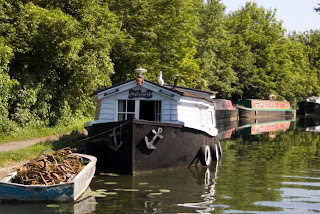 Boats with character on the bottom end of the Grand Union
Now I hear a lot more complaints about almost everything. Some people are as disparaging and unpleasant about continuous cruisers and live-aboards as others, in earlier times, used to be about Jews or immigrants, and with little reason other than either jealousy or bigotry.
Others complain about the number of boats moored on-line because it means they can't rush past in their hurry to get somewhere. I always assume these are the people who can afford the fees charged by marinas and think every canal user has the same resources.
Surely the whole point of boating on the canal system is the slow pace? What does it matter if it takes you an hour more to get somewhere?
Now we have the row over moorings on the River Lee in London. BW claims they are not carrying out social cleansing because of next year's Olympics when they decide to crack down on the people who use boats on the river, threatening large fines and making extremely aggressive noises through their inaptly titled Head of Boating Sally Ash.
I would like to know whether any of the local towpath users or visiting boaters are upset by these people? Certainly different rules seem to apply to mooring limitations in London as a whole, but in my time there I have not felt excluded by the presence of a floating population. They are part of the scenery and usually pleasant and sometimes fascinating individuals.
Of course, you actually have to be travelling slowly enough to get off your boat and meet and talk to people to appreciate that.
Unfortunately British Waterways senior managers rarely talk to anyone, never mind real boaters, and are sadly out of touch. If they were not they would realise just what most boaters actually feel about them retaining their grossly inflated salaries whilst sacking far to many real workers on the bank.
And if you think this attack on boaters is limited to London and the Olympics, think again. BW has just announced plans to set up more @local Waterways Partnerships@ in the Midlands and North West following on the one on the Kennet and Avon where Sally Ash managed to become heartily disliked by boaters and local councillors.
These partnerships aim to give a say to local councillors, and other parts of the 'establishment' in the running of their local canals. You can bet your life there will not be a live-aboard boater, a continuous cruiser or anyone who actually uses and knows the canal system represented on such boards.
Headed by BW's regional managers and, I suspect backed by the wealthy, shiny boat brigade as well as the sort of people who want to live by canals without the inconvenience of having real boats on the water, they are likely to focus on making life as difficult and expensive as possible for those who have made the canals their way of life.
Expect more restrictions, more fines and more attempts to make canals fit for the denizens of expensive marinas when they bring their boats out for the annual airing.
When I started boating it was because I wanted something that forced me to slow down and stop becoming irritated at the unimportant and the British canal system has delivered that. Most of all I have had great enjoyment from the idiosyncratic population of the waterways, the characters who use, inhabit and deal with the problems of boats.

Now I hear a lot more complaints about almost everything. Some people are as disparaging and unpleasant about continuous cruisers and live-aboards as others, in earlier times, used to be about Jews or immigrants, and with little reason other than either jealousy or bigotry.
Others complain about the number of boats moored on-line because it means they can't rush past in their hurry to get somewhere. I always assume these are the people who can afford the fees charged by marinas and think every canal user has the same resources.
Surely the whole point of boating on the canal system is the slow pace? What does it matter if it takes you an hour more to get somewhere?
Now we have the row over moorings on the River Lee in London. BW claims they are not carrying out social cleansing because of next year's Olympics when they decide to crack down on the people who use boats on the river, threatening large fines and making extremely aggressive noises through their inaptly titled Head of Boating Sally Ash.
I would like to know whether any of the local towpath users or visiting boaters are upset by these people? Certainly different rules seem to apply to mooring limitations in London as a whole, but in my time there I have not felt excluded by the presence of a floating population. They are part of the scenery and usually pleasant and sometimes fascinating individuals.
Of course, you actually have to be travelling slowly enough to get off your boat and meet and talk to people to appreciate that.
Unfortunately British Waterways senior managers rarely talk to anyone, never mind real boaters, and are sadly out of touch. If they were not they would realise just what most boaters actually feel about them retaining their grossly inflated salaries whilst sacking far to many real workers on the bank.
And if you think this attack on boaters is limited to London and the Olympics, think again. BW has just announced plans to set up more @local Waterways Partnerships@ in the Midlands and North West following on the one on the Kennet and Avon where Sally Ash managed to become heartily disliked by boaters and local councillors.
These partnerships aim to give a say to local councillors, and other parts of the 'establishment' in the running of their local canals. You can bet your life there will not be a live-aboard boater, a continuous cruiser or anyone who actually uses and knows the canal system represented on such boards.
Headed by BW's regional managers and, I suspect backed by the wealthy, shiny boat brigade as well as the sort of people who want to live by canals without the inconvenience of having real boats on the water, they are likely to focus on making life as difficult and expensive as possible for those who have made the canals their way of life.
Expect more restrictions, more fines and more attempts to make canals fit for the denizens of expensive marinas when they bring their boats out for the annual airing.
Thursday, 10 March 2011
How not to make friends for the waterways
Sally Ash strikes again! The poorly titled Head of Boating for British Waterways has acquired a reputation as something of a pit bull when it comes to dealing with boaters.
She seems to find it difficult to relate to boaters in any way and usually fails to understand how valuable boats are to the waterways. Many report the feeling that her ideal is a canal and river system with all the boaters neatly penned in marina.
Now, as the Guardian reports, she is using the Olympics as an excuse to hound live-aboard boaters off the River Lea.
If British Waterways is to become an effective charity it will need something more than local councils and the 'great and good' to enable it to keep the canal system going. Most of all, it will need the support of those people who know the canals and rivers best, the people who spend most of their lives on boats on the system.
Sally Ash has done little in her time in office but alienate not just boaters but several of the voluntary organisations linked with the waterways. I wonder if she hasn't become more of a liability than an asset at a time when British Waterways needs friends like never before.
Two things would help - the departure of Sally Ash and the over-paid directors like Robin Evans halving their enormous salaries.
http://www.guardian.co.uk/sport/2011/mar/09/houseboaters-socially-cleansed-olympics
Monday, 21 February 2011
The myth of contracting out work
It was the Conservatives under Thatcher who first persuaded us to believe as a country that when any sort of work or service went out to the private sector for tender we were in some way saving money.
That was the same belief that led to the selling off of our railways, coal mines, water, electricity and gas industries to say nothing of our steel and even our airports and ports.
We see it now in every organisation that has any link to government and British Waterways has been a prime example. In order to tick the box of competition they not only use contractors to repair the canals and canal structures they even brought in the ludicrous moorings auctions before distorting them by setting ridiculous reserve prices to avoid boaters getting a mooring for £10.
The results are also all around us. We no longer have a coal industry because it was not sufficiently profitable for the private owners and we now import coal and are having to pay ever-increasing prices as we compete with the Chinese and Indian markets.
Our multitude of railway companies are interested solely in profit and, in addition to rising fares whenever possible also fail to invest in their rolling stock. In stead of the entrepreneurs we were promised we have companies who treat rail franchises as cash cows.
If we still owned the water and power companies then at least their enormous profits would be going into the public purse and there would be more of that invested in green energy.
As for contractors on the canal system, it still seems that BW and others have a problem with some simple arithmetic. Contractors employ staff on the lowest possible rates and use the materials that give them the biggest profit margin.
If British Waterways used their experienced staff, who are not paid much more than basic rates, and utilised their expertise they would not be paying the contractors' profits and would get a better job from staff who would know they are valued.
The same is true throughout the system but now we have Cameron wanting everything to be up for grabs by private companies so the taxpayer can pay for their profits - including the NHS, education and any other service the poorest of our community needs.
That will not be cheaper for the taxpayer and it certainly will provide a lower and nastier service, ruled by the profit motive, for every user of every school, hospital or even job centre.
That will take us to a grubby commercial world in which the spivs and cowboys of business, especially those who donate most to Tory party funds, controlling every aspect of our lives, with the government able to wash its hands of any responsibility. "We will, of course, investigate whether the private firm concerned has been ripping you off," they will promise and, of course, nothing will happen.
If we allow this we deserve to be taken to the cleaners - and we surely will be.
Tuesday, 31 August 2010
When ecology meets commerce on the canals
A developer is aiming to put a 90 berth marina on the Montgomergy Canal, which will eventually link Britian's busiest canal - the Llangollen - with the pretty Welsh border towns of Welshpool and Newtown.
The marina, at Queen's Head near Oswestry, seems to have the backing of the local council and British Waterways but it will prove to be a headache for the naturalists and ecologists who see the canal as some sort of linear nature reserve rather than a navigation for narrowboats.
Currently there are severe restrictions on the number of boats able to use the canal and parts of it are within a Site of Special Scientific Interest (SSSI). Rare plants and insects thrive in the weedy margins of the seven mile stretch of canal currently opened and boaters are limited to speeds as low as 2mph in places with one-way traffic in some sections.
It is difficult to see that limit, or the current limit of a few hundred boats a year surviving the influx of a large marina.
It may well improve the prospect of opening the currently closed section with another 11 mile stretch around Welspool which is already re-opened. If that happens, the number of boats will increase dramatically as Welshpool will become as popular as Llangollen as a destination.
It is difficult to see the harmony of plants insects and boats surviving the return of the Montgomery canal to full working status but both the local councils and British Waterways need the extra income.
Thursday, 20 November 2008
Time to turn our back on Thatcher's legacy
href="file:///C:%5CDOCUME%7E1%5CPETERU%7E1%5CLOCALS%7E1%5CTemp%5Cmsohtmlclip1%5C01%5Cclip_filelist.xml">
IT has become a cliché to blame Margaret Thatcher for the current ills of our society but I am increasingly convinced that we have to turn to the mad old cow (as I like to call her) to explain what is happening to us today.
It was the Thatcher regime that decreed public sector was bad and private good – and then went on to sell off, mostly to Tory supporters, the railways, British Telecom, the electricity and gas companies and the coal and steel industries.
All, we were assured would be much more efficient run for profit in the private sector.
She also brought in what has become a touchstone of national and local government and every public institution from schools to hospitals – the idea that better value comes from contracting out ( or outsourcing as the modern terminology has it) as much as possible. Once again, market forces would be the solution to all our problems.
Thirdly she began the process that removed almost all public oversight and regulation from the banking sector, allowing them to go their own way in the name of ever bigger profits and bonuses.
The results are all around us. As the financial sector collapses from an overdose of greed and stupidity, the UK is left without any substantial manufacturing industry because it has been flogged off and then sold on to foreign buyers before being closed as ‘uneconomical’
Most people are suffering financially because the privatised energy industry is focused on profit and refuses to pass on falls in wholesale prices while it can feather its own nest with increased income.
In the public sector, private contract and private contract either fails to deliver – like the schools payment firm which has just been fired – or costs twice as much as originally planned, as can be seen from virtually every IT contract the government has let.
The result is that we are suffering from an overdose of private greed, disguised as ‘market forces’ and even the Labour Party has been unable, until now, to utter the heresy that market forces are not the answer to every problem.
Thatcher created a demon out of those ordinary people who worked for British Steel, British Rail or cleaned hospitals as employees rather than exploited contractors. She told us it was wasteful to employ people directly and much better to have the flexibility of contractors you could fire when necessary.
Now is the time to question that dogma in every sphere. If we had a regulated financial system we wouldn’t have bought bundles of doubtful debt from America.
If we had nationalised power companies we would not only be able to smooth out the price hikes they have demanded but their profits could have gone into the public purse to pay for the renewable energy development we now need.
Almost every public institution would be better served by direct employees who developed loyalty and understanding as a result of being paid and treated fairly – to say nothing of having a proper pension to look forward to. Who doubts that hospitals were cleaner when the workforce was not provided by dodgy ‘hygiene’ firms?
The mantra of capitalism that private ownership and competition results in the best of all worlds is being proven to be a big lie across the world and in our own back yard. The Labour party under Tony Blair repeated that mantra at every possible occasion to reassure the middle classes but that doesn’t make it right and there is no longer a need to do so.
The Thatcher revolution has ground to a halt amidst debt and bankruptcy because it never took account of the nature of those who ascend to the top of a system based on greed that allows the terminally stupid to control the future of others.
It is time to turn back to the concept of public service, loyalty, fairness and stability that was inherent in our system when the major elements of our economy were owned and controlled by all the people of this country, not just by a few rich individuals, many of them without any real ties or loyalties to Britain.
If it makes you nervous you don’t even have to call it socialism – let’s have a new creed of pragmatism that says never again will we let the greedy bastards take control of our work, health, education, homes and money.
Subscribe to:
Posts (Atom)


 Posts

